
Coconino County Crime News Sources
Start with the agencies themselves. The Coconino County Sheriff's Office release feed posts notices about incidents, searches, arrests, and public-safety events, sometimes with agency-chosen images. The Coconino County Attorney news feed steps in when a charging decision warrants public comment. Both are picky about what they publish. Neither one serves as a day-by-day roster of everyone booked into the Coconino County Detention Facility. Treat them as announcements, not a complete arrest log. The CCSO release page appears in the captured source below.
These posts are a starting point, nothing more. To learn who is actually in custody, call the jail, request a specific booking record, or check the court docket. Social media works the same way. Police and county accounts spotlight the events they choose, which leaves plenty of arrests unreported and makes an independent Coconino County arrest log worth consulting alongside them.
Coconino County Arrest Outlet Map
Coconino County has no verified official booking feed, whether same-day, 48-hour, 72-hour, or weekly. So coverage fragments along geographic and editorial lines. Flagstaff sources run strongest near the county seat. Page gets a Lake Powell outlet. Williams and the Grand Canyon share a paper of their own, while northern Arizona reporting often crosses county, tribal, state, and federal boundaries. Read each of the sources below with its real scope in mind.
| Outlet | Coverage | Photos? | Publication pattern |
|---|---|---|---|
| CCSO releases | Official county incidents | Sometimes | Selective agency posts |
| County Attorney news | Official charging and prosecution news | Varies | Event-driven releases |
| FlagScanner | Flagstaff-area detention bookings | Text-first logs | Frequent daily dates and weekend compilations |
| Arizona Daily Sun | Flagstaff and county crime or courts | Varies by story | Event-driven reporting |
| KAFF | Regional public safety | Varies by story | Event-driven reporting |
| Lake Powell Chronicle | Page and Lake Powell area | Varies by story | Selected local news |
| Williams-Grand Canyon News | Williams and Grand Canyon area | Varies by story | Selected local news |
| Navajo-Hopi Observer | Northern Arizona and tribal areas | Varies by story | Selected regional news |
| Mugshots.com | Sparse private Coconino archive | Yes, where listed | Unofficial and dramatically stale |
Where a story breaks tells you little about who made the arrest. A report near Page or on tribal land might involve Page Police, the Sheriff's Office, a tribal department, Arizona officers, or a federal agency. Sedona complicates things further. It straddles Coconino and Yavapai Counties. Outlet geography never settles arresting authority, jail location, or court venue. Those answers live in the agency record and the case paperwork.
Note: A quiet day at an outlet may just be an editorial choice or a delay, not a verified arrest-free day.
FlagScanner Coconino Arrest Log
FlagScanner is a standout among Coconino County booking-news sources. Its Flagstaff Area Arrest Log publishes often. Expect daily entries plus weekend roundups. Most posts list names, booking times, and charges drawn from Coconino County Detention booking lists. There is no mugshot gallery here. The format is almost entirely text, which makes the log handy for discovery, though it is neither official nor complete.
The FlagScanner arrest-log hub is shown in the next source capture.
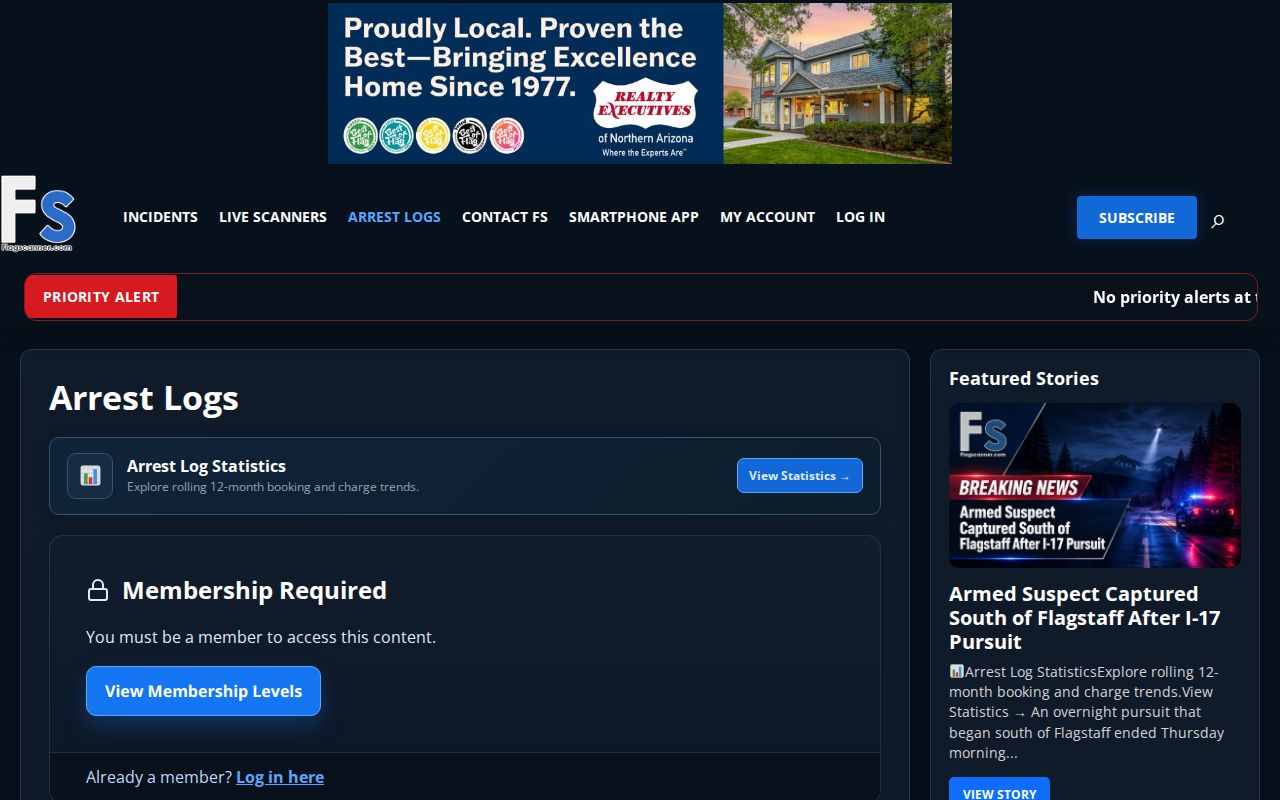
The capture displays the arrest-log area and its independent presentation, though some material sits behind access limits past the landing page. Keep its reach in perspective. The feed leans heavily toward Flagstaff-area admissions to Coconino detention. It is not a Sedona or Page police blotter, and corrections, releases, transfers, citations, and final outcomes can slip past it entirely.
The county's quarterly jail reports offer something different. They tally intake times, charge data, release reasons, demographics, and impairment measures, while excluding prisoners in transit and "print & mug" encounters. Database corrections can revise earlier totals, too. Use them for trend analysis, not to hunt for a name from today's arrest report.
How Coconino Mugshots Reach News
Ever wonder how a photo ends up beside a Coconino County crime story? Several routes exist. An agency may attach a suspect image to a hand-picked release. A reporter may request a releasable booking photo. Outlets also fall back on scene shots, file photos, or other agency-supplied pictures. That is why the label matters. An image should carry its actual source and date rather than being mistaken for the latest jail intake photo.
CCSO posts no open web roster with photographs. Getting a specific booking image means going through the county records route, where review and redaction still apply. Arizona public-record law allows inspection of public records, yet it does not promise that every police image gets released. Juvenile material, victim details, active investigations, court orders, and other protected interests can all block disclosure.
Private publication is another world from agency custody. Of five mugshot aggregators examined, just one live county page turned up. The Mugshots.com Coconino page is documented below as part of that landscape.
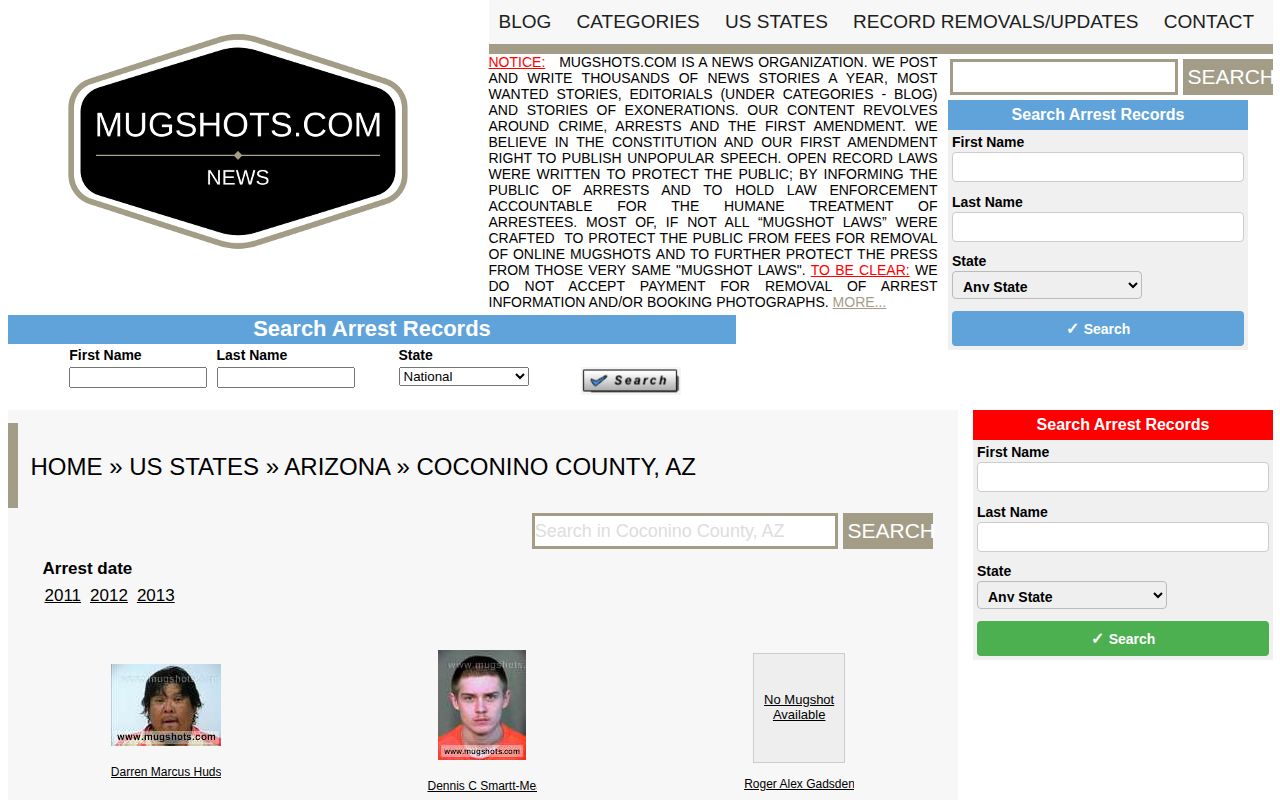
That page held only three county records. Year filters covered 2011 through 2013. It is a sparse historical aid, plain and simple. It is not a recent-arrest feed, a custody source, or a complete archive. Busted Newspaper had no verified Coconino section. Recently Booked's former route had vanished. No Coconino inventory could be confirmed for Arrests.org or Mugshots.zone either. Treat dead or guessed routes as dead ends, not local resources.
Note: Private listings can be stale, incomplete, misidentified, or detached from the court outcome; verify each event with official records.
Coconino Indictments Are Allegations
The Coconino County Attorney's office draws a helpful line in its own releases. A grand-jury indictment, in its framing, is a charging paper. It rests on a probable-cause finding. Nothing more. That framing is worth keeping in mind whenever a headline, an arrest log, or a booking photo crosses your screen.
- Arrest
- An agency takes a person into custody or begins an charge process.
- Booking
- A jail records intake details, booked charges, and administrative custody status.
- Indictment
- A grand jury finds probable cause for stated charges. The charges remain charges.
- Disposition
- The court record shows dismissal, plea, verdict, judgment, sentence, or another final action.
Cases move through stages. Keep the stages apart. A police release may come before any case is filed. The charge at intake can differ from what the prosecutor files. A preliminary hearing might end in dismissal. It might instead end in an order to stand trial. Charges can also be amended after filing. Some are dropped.
From Coconino Story to Record
A name in a Coconino County news story is a lead. Nothing more. Start by confirming the story is about the right person. Confirm the right event too. Common names invite false matches. Later corrections and separate cases do the same. Then work from the publisher to the office holding the person in custody. Finish with the court handling the case.
- Record the person's full name, event date, location, arresting agency, and any report or case number printed in the story.
- For possible current Coconino custody, use the jail phone route. There is no official CCSO web roster or named booking feed.
- Request the booking sheet, releasable booking photo, or incident report from the agency that holds each item. A jail record and police report can have different custodians.
- Search Arizona Public Access by case number when possible, identify the exact court, and use the clerk or eAccess for authoritative documents.
- Follow the docket to dismissal, plea, trial result, judgment, sentence, or another final entry. Match the court, case number, date, and exact count.
The Coconino County booking and custody hub lists the county phone number and the records-request path for a reported arrest. A current-custody check won't help for someone already released. A sentenced state prisoner belongs in the state corrections search instead. Neither status can be read off an old headline.
Arizona Public Access cautions that its information may be incomplete or out of date. Participating courts refresh their data weekly. Sealed or confidential records never appear. If a portal result seems unclear, ask the clerk of the named court, who is the authoritative source. Sedona sits across two counties. Separate tribal courts operate here too. Venue checks matter more than usual.
Coconino Crime News Cadence
No Coconino County outlet reports every arrest on a fixed schedule. FlagScanner posts frequent daily and weekend logs. The Arizona Daily Sun, KAFF, Lake Powell Chronicle, Williams-Grand Canyon News, and Navajo-Hopi Observer cover events as they see fit. CCSO and County Attorney feeds are official but selective. A missing story may reflect timing, access, geography, or editorial judgment.
Read in a consistent order. Official release comes first. Independent coverage comes second. Private archive comes last. Confirm current custody through the proper jail channel, get the event record from its custodian, and follow the court docket to its end. That chain keeps Coconino County crime news tied to the record itself.